← Home
Oleksandr Ignatiev · A photography project

Photo
Stories

Ten photographs. Ten short stories about what stayed outside the frame.

A photograph stops a moment in time.

But it hardly ever tells you what happened a second before. Who was standing nearby. What the air felt like. What lay outside the frame. Why the photographer pressed the shutter just then, and why, years later, the picture still makes you linger.

This project brings together ten photographs by Oleksandr Ignatiev.

And ten short stories that took shape alongside them.

They are neither explanations nor captions. Nor do they tell the viewer what to see.

Think of them as another way into the frame.

Spend a few minutes by the river in the fog. See an old boat as something more than an object. Stop on a winter street you might pass without noticing by day. Look closely at the web among the poppies. Feel the distance between a person, the water, time and memory.

Something quiet always remains in a photograph.

Sometimes that is where a story begins.

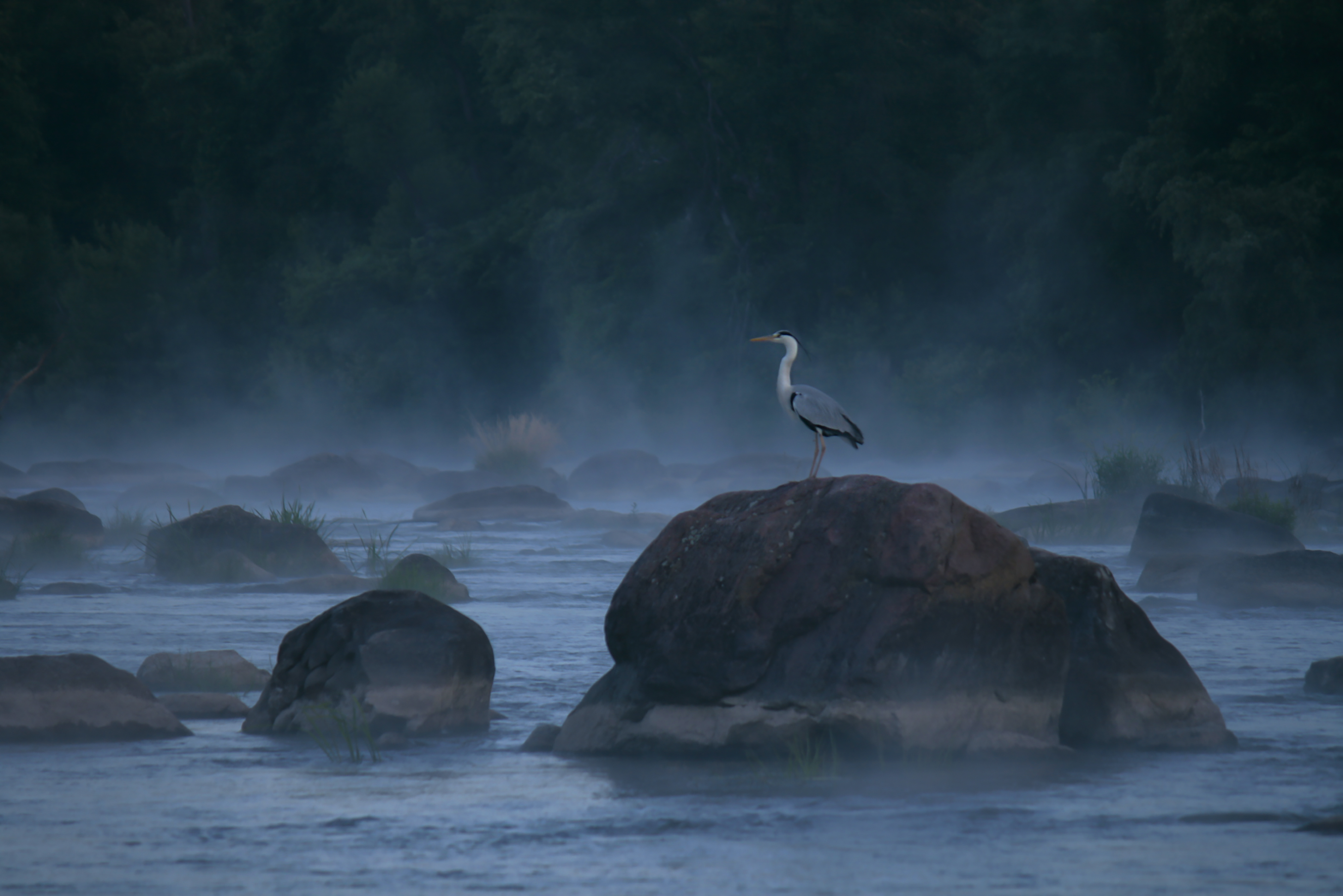
Guardian of the Boh River — a heron on a rock in the middle of a misty river
Oleksandr Ignatiev · Guardian of the Boh River
STORY 01

Guardian of the Boh River

A Lesson in Stillness

We did not see her at first.

First came fog. Stones. Water. And that strange morning mood of the river, when it seems not quite awake.

Then my assistant touched my shoulder.

“Look.”

A heron stood on a rock.

We stopped.

I took out my binoculars. He took another step forward.

The heron did not move.

One more step.

Then she simply flew to another rock. Not far. Twenty metres or so.

We came closer.

She flew off again.

It happened several times.

At last my assistant spoke.

“She saw us.”

“Long before you saw her.”

We went no farther. We simply sat on a rock.

After a few minutes, the heron stopped looking our way. Water slipped between the boulders. The fog slowly lifted.

Suddenly it was clear. All this time we had tried to close the distance. We needed to do the opposite.

Leave her be. Give her room.

Because sometimes the best way to get closer to something beautiful is to stop approaching it.

The heron kept flying away.

And we finally stayed put.

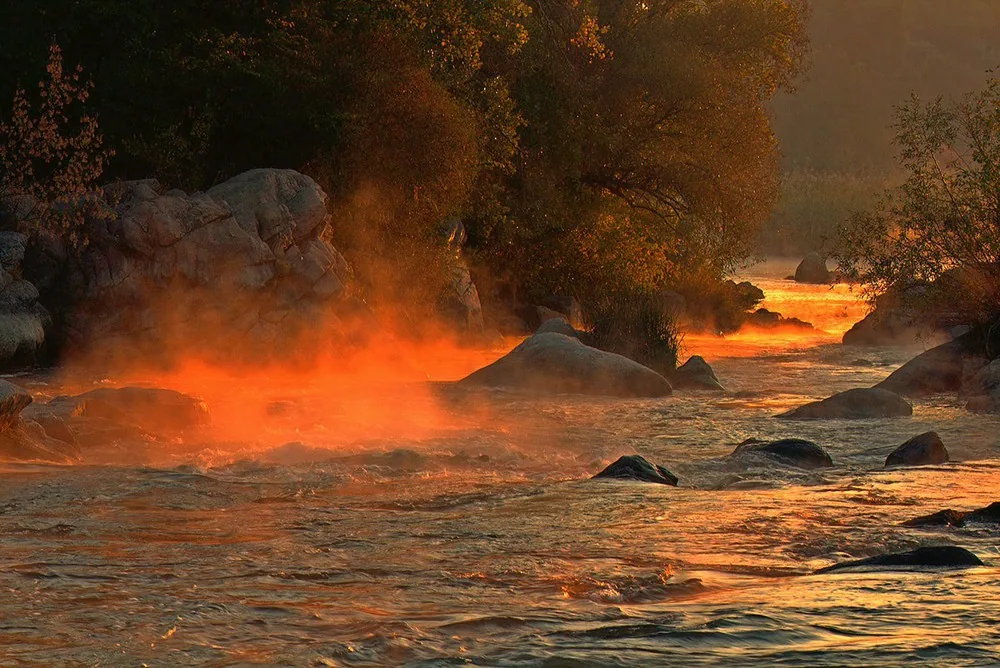
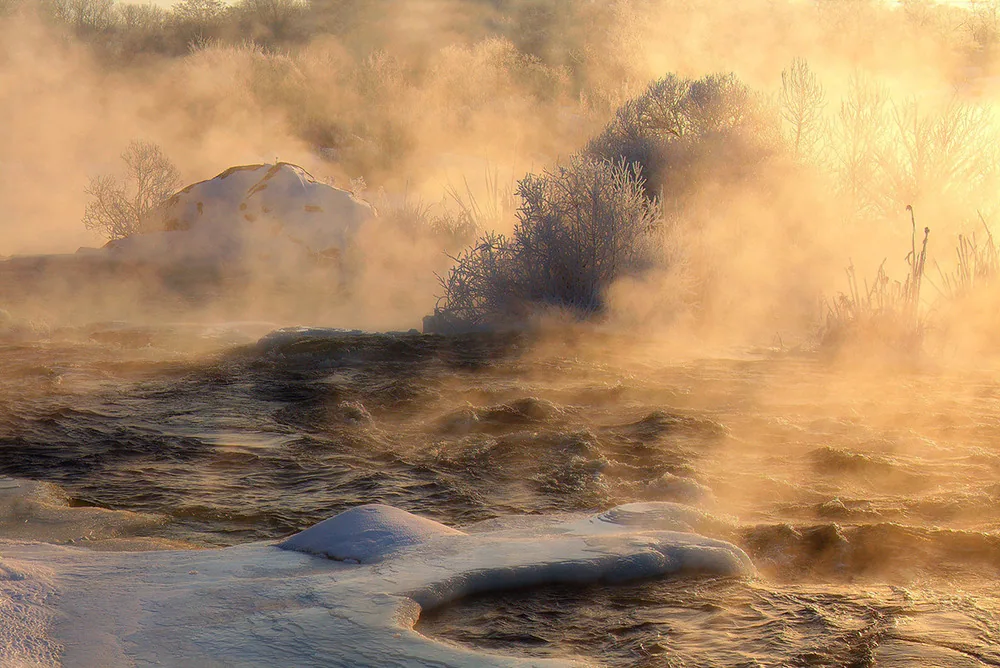
Magma of the Hypanis — orange light and haze above the current between dark rocks
Oleksandr Ignatiev · Magma of the Hypanis
STORY 02

Magma of the Hypanis

Water That Looks Like Fire

Water does not burn.

But in front of this photograph you forget that for a moment.

Orange light rests between the dark rocks. It touches the current, rises above it in a thin haze and vanishes where the bank bends into shadow.

It looks as if the rocks have just parted and released something hot.

Hence the title, “Magma of the Hypanis.”

Hypanis is one of the historical names of the river now known as the Southern Bug. The photographer identifies the location of this work as Buhskyi Hard National Nature Park.

Here the river has a character quite different from that of a broad, quiet stretch of water.

It meets a rock.

It parts around it. Comes together again. Leaves folds, small crests and dark streaks on the surface.

You can follow that movement for a long time in this photograph.

At first your eye holds to the brightest patch deep in the frame. Then it follows the light to midstream. Only then does it notice the water close at hand, its uneven, living surface.

The rocks keep you from getting lost.

They are heavy. Still. You can trace their edges with your eyes.

Light behaves differently.

It has no clear edge. Here it lies on the water. A little farther on it becomes haze, then dissolves between the trees.

That difference is what holds the eye.

Stone gives a sense of duration. Water, of movement. Light, of a moment you cannot hold in your hands.

We often look at a landscape as a place.

Here is the bank. Here is the river. Here are the trees.

Here, what happens between them matters more.

Dark rock makes the light brighter. The current breaks it into hundreds of small reflections. The haze lets you see colour even above the water’s surface.

It all works together.

The title invites us to picture magma. The photograph leaves us with the river, its rocks, trees and current.

You can look at it as an almost fiery landscape.

Or you can come back to the simplest thing: light above water.

And that is enough to make you linger.

Because a familiar river need not look familiar every time.

Duty Done
STORY 03

Duty Done

The Right to Go Nowhere

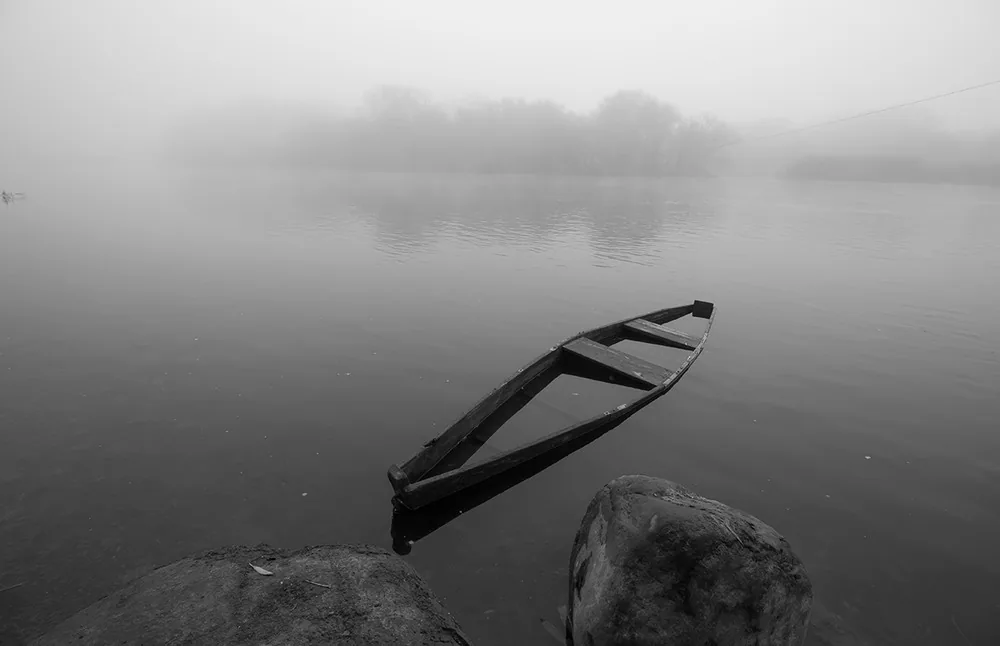
This boat is in no hurry to go anywhere now.

Once it had a very simple purpose.

Untie the rope. Push off from the bank. Head for darker water.

To the far bank. To the reeds. To the net.

Or simply to where the fish are biting in the morning.

Now it sits still.

Water and time have darkened the wood. The side has warped a little. Rain collects in the bottom.

And yet there is nothing abandoned about it.

Quite the opposite.

It looks as though it has finally earned the right to go nowhere.

Meanwhile the river does what it has always done.

Mist lifts off the water. The rocks grow wet. The current curves along the bank.

The boat stays.

And in the middle of this morning it suddenly looks like more than an old thing.

A witness.

It remembers the weight of a person in the stern. Wet boots. The rasp of the rope. The creak of the oars.

Someone might yet repair it.

Or they might not.

We tend to think that things vanish when they are no longer useful.

But sometimes that is when we first notice them.

We no longer see a way of getting somewhere.

We see proof that someone was here before us.

Flood, 2024
STORY 04

Flood, 2024

Stone

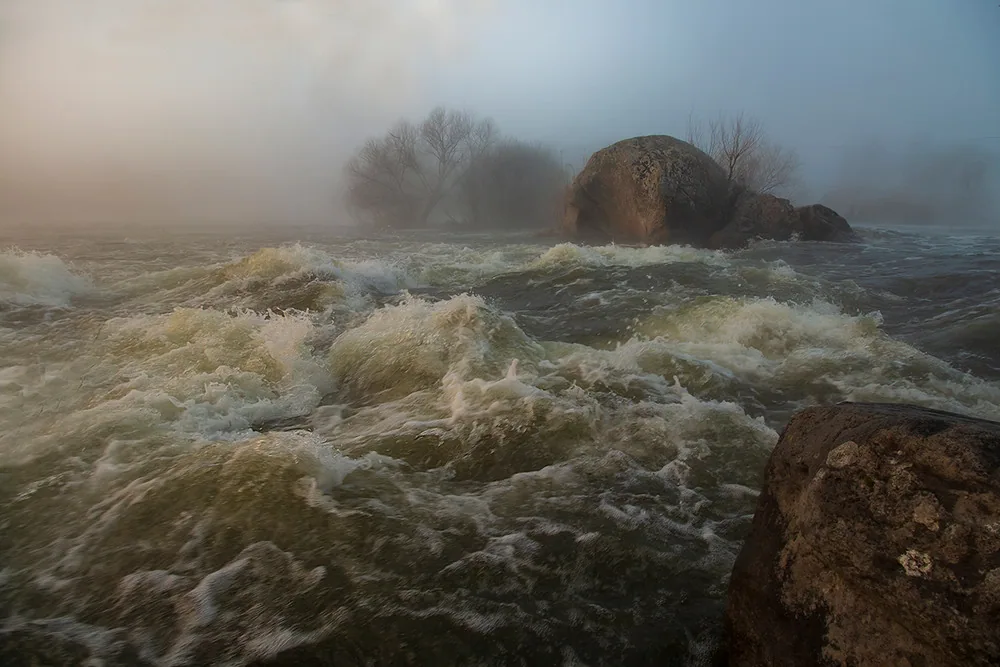
In the photograph, water seems to be the main character.

White with foam. Swift. Loud even in a silent image.

But every time, I see the stone first.

It stands in the middle of the current.

Water strikes it, splits, goes around on either side and rejoins farther down.

If we looked for only a second, we might decide that the stone had won.

It stayed where it was.

And the water had to yield.

But the river knows no such word as “yield.”

It simply keeps moving.

If not today, then tomorrow. If not over the top, then around the side. If not by force, then with time.

Water does not argue with stone.

It goes around it.

Perhaps that is the strange advantage the current has over everything that stands still.

It does not have to win now.

It has a direction.

And it has time.

We often admire what can stand its ground.

Strength. Steadfastness. Resistance.

The river reminds us of another kind of strength.

The ability to keep going.

Even with a stone ahead.

Especially with a stone ahead.

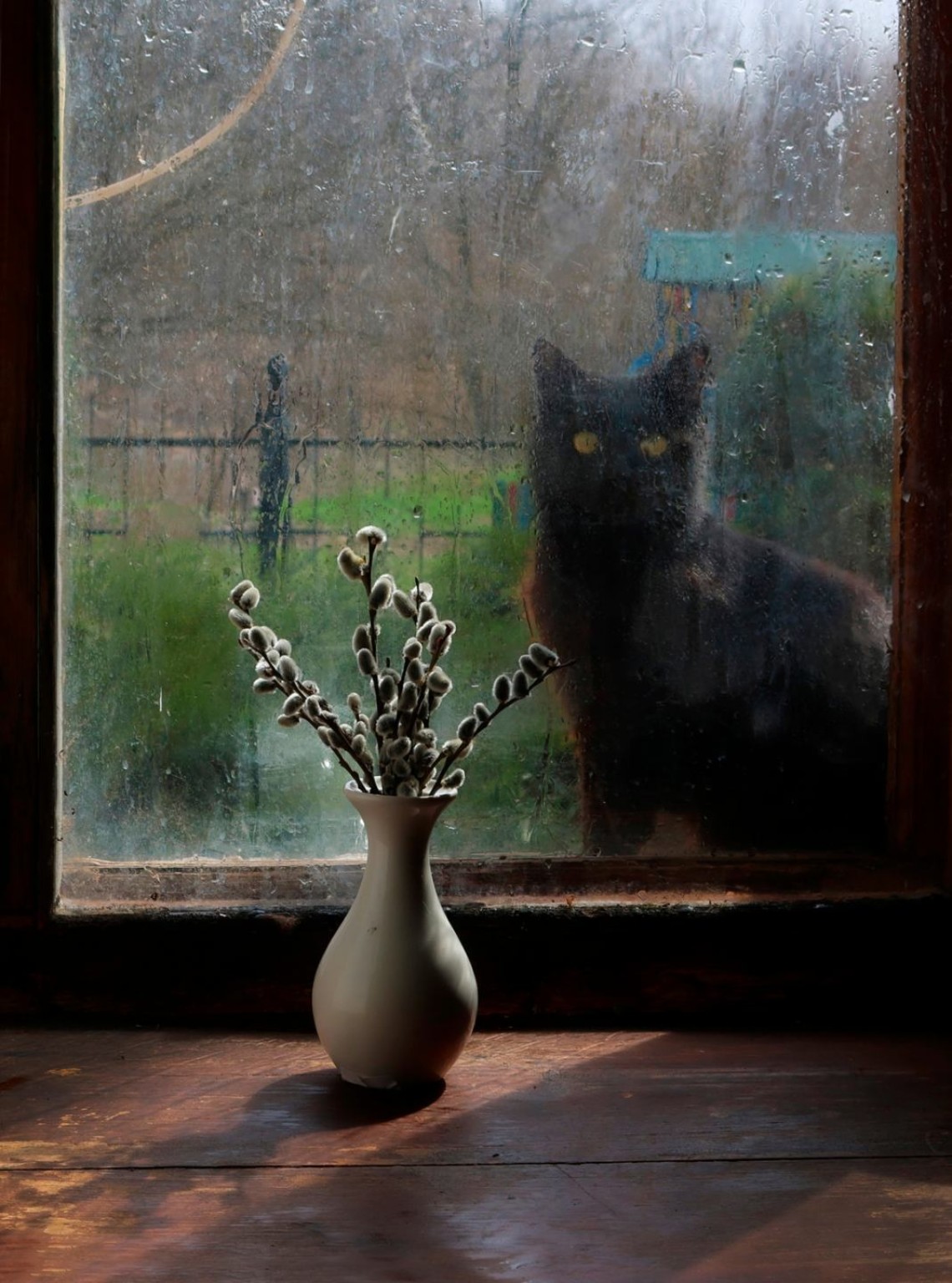
March Catkins — a cat outside the window and willow catkins in a vase
STORY 05

March Catkins

Who Gets to Be Spring?

Willow branches stand on the windowsill.

A few days ago they were hardly noticeable.

Just thin twigs brought in out of the cold.

Now soft, pale catkins have appeared on them.

And at that very moment, a real cat appears in the frame.

Dark.

On the other side of the window.

He looks in as though he thinks the whole thing is a bad joke.

Someone went and called the willow buds catkins.

Now we have to work out which one is the real thing.

Sometimes nothing momentous happens in a good photograph.

Nobody is running. Nothing explodes. History is not being made.

Two things that until then had lived separate lives suddenly meet in one rectangle.

A willow. And a cat.

March has a way of arranging little encounters like that.

It is still cold, but there is more light.

The trees are still bare, but their buds already know something we cannot yet see.

Spring rarely makes a grand entrance.

First it leaves little clues.

On a branch. On a windowsill. In a longer evening.

Sometimes it simply puts a cat outside the window.

So we finally notice the catkins.

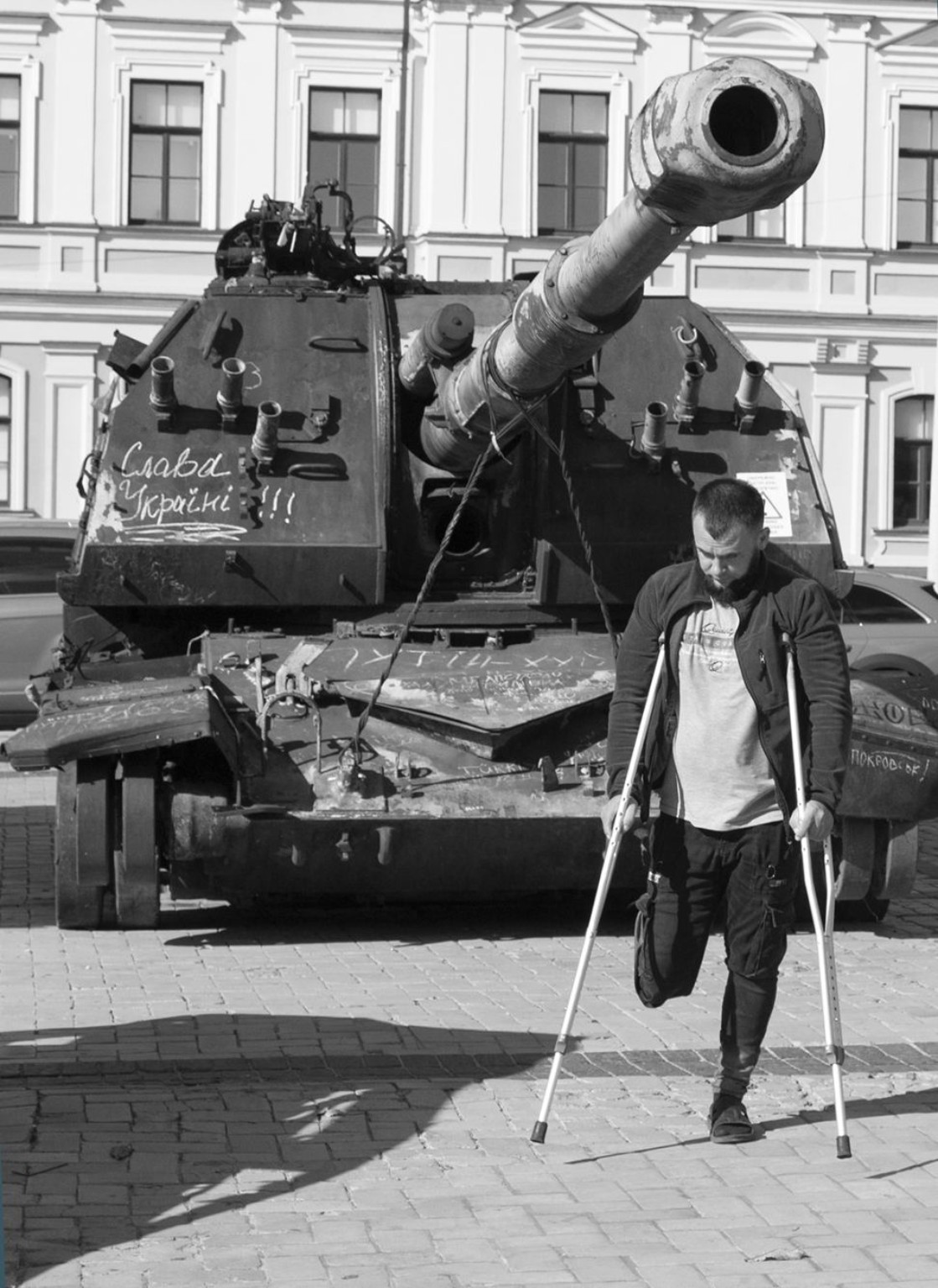
The Winner and the Loser — a man on crutches beside a damaged self-propelled artillery vehicle
STORY 06

The Winner and the Loser

Independence Has a Human Cost

In this war, Ukraine is defending its right to be itself.

To have a state of its own. To speak its own language. To live on its own land and decide its own future.

This is a war for the country’s independence. Its cost cannot be captured in dispatches from the front.

In the photograph, a person on crutches walks past a damaged military vehicle.

Side by side, a body that needs support and metal that no longer looks like an invincible force.

The title, “The Winner and the Loser,” asks us to pause here.

It is easy to imagine victory as flawless. Flags, joy, coming home. But the road there runs through loss, pain and a long recovery.

That is why the crutches in this picture do not mean defeat.

An injury does not take away a person’s dignity. Needing help does not make them weaker than those looking at the photograph.

We do not know this person’s story, and a single photograph cannot tell us what caused the injury. But in the context of the war, the image inevitably brings to mind those who sacrificed their health defending Ukraine.

Service members returning from the front. Civilians whose lives were changed by shelling, mines and occupation. Families learning to live with the consequences of Russian aggression.

Here, the word independence takes on a human scale.

More than a border on a map.

The freedom to walk down your own street. To return to your loved ones. To be at home without a foreign power deciding whether you have a right to your own country.

That is what Ukrainian resistance defends.

In the frame, the person moves. The vehicle stays still.

That contrast becomes an image of life going on despite the war. With pain. With loss. And with the right to a future.

At the same time, the photograph asks an uncomfortable question of those of us looking at it.

What are we doing for those who return?

Gratitude alone is not enough when someone is then left to face stairs, inaccessible transport, treatment or a job search on their own.

Respect for those defending their country must carry through to everyday decisions about rehabilitation, accessible places, support for families and the chance to live a full life.

That, too, is part of our responsibility for the country we defend.

Ukraine’s victory will not undo what people have lived through. It will not automatically restore their health. It will not erase the memory of those killed.

But it must preserve what the resistance is fighting for: our state, our freedom and the right of future generations to live in an independent Ukraine.

The person in this photograph takes another step.

Our duty is to remember what that step costs. And to be there.
An Angler at Rest
STORY 07

An Angler at Rest

The Fish That Wasn’t

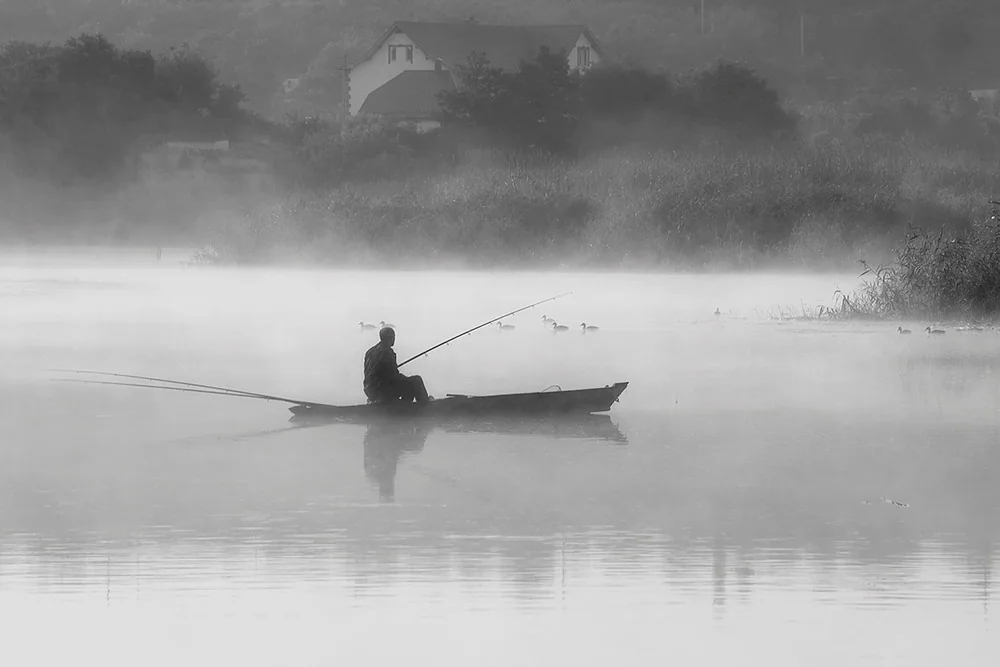
He sits alone in the boat.

Fog all around.

The water is almost still.

If you really wanted to invent a plot, you could say he is waiting for a big fish.

But I like a different version.

Maybe the fish has nothing to do with it.

Maybe a fishing rod is simply a good excuse to wake up before everyone else.

Push the boat away from the bank.

Row far enough that you can no longer hear the road, doors, phones or other people’s voices.

And then sit.

Hurry nothing along.

Stop checking how many minutes have gone by.

Ask nothing of the morning.

We have a strange way of thinking about time in which nothing happened.

We call it wasted.

Yet those are sometimes the hours we remember longest.

Fog over the water.

A cold oar in your hand.

A few rings on the surface.

A bank that has almost disappeared.

And absolutely nowhere you need to hurry to.

Perhaps he caught nothing that morning.

And went home empty-handed.

But the photograph leaves us with another question.

If you spend two hours somewhere you feel at peace…

have you really come back with nothing?

The Small World of Poppies
STORY 08

The Small World of Poppies

No Straight Way Through

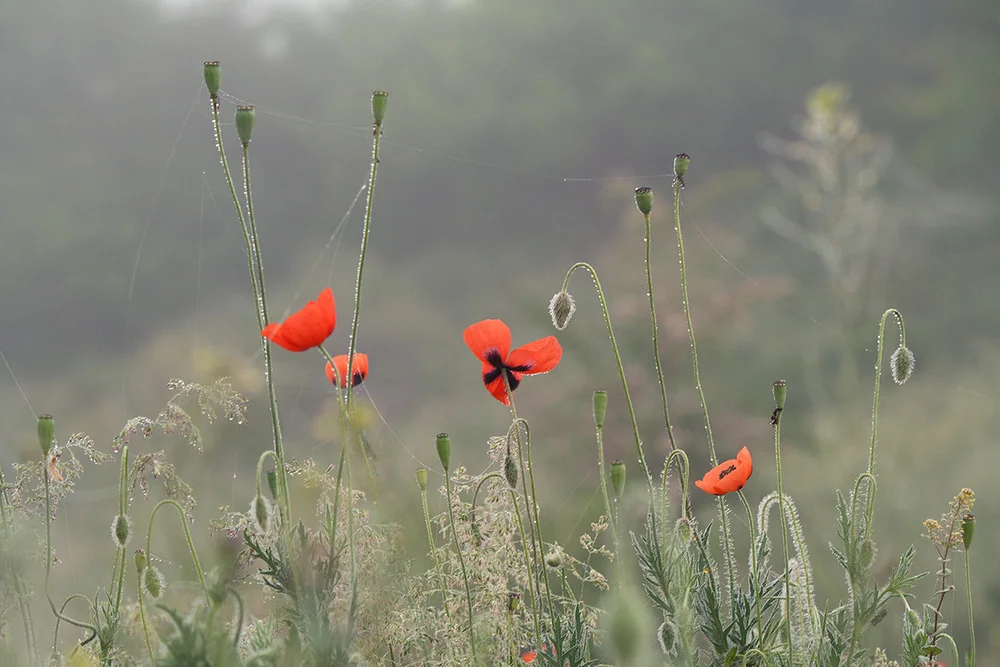
From a distance, they are just poppies.

A few red patches in the grass.

Beautiful.

You can glance for a second and move on.

Come closer, though, and the space suddenly grows intricate.

A spiderweb stretches between the stems.

Fine threads cross the emptiness.

A drop hangs from one of them.

And what looked like a clear passage between the flowers turns out to be someone’s route, trap, bridge, home.

The little world has one strange quality.

It exists whether we notice it or not.

The spider does not wait for the photographer.

The poppy does not open for the camera.

The grass does not part to make a cleaner composition.

It is all already happening.

Without us.

Maybe that is why macro photography changes how we see.

It does not make small things bigger.

It makes us less certain that we see everything.

Suddenly one square metre of meadow becomes an entire landscape.

With roads. Crossroads. Heights. Dangers.

And inhabitants we had not even noticed.

After that, cutting straight through feels a little awkward.

Because now you know.

Where you see only grass…

for someone else, a whole world stretches out.

Winter Night
STORY 09

Winter Night

The Light That Waited

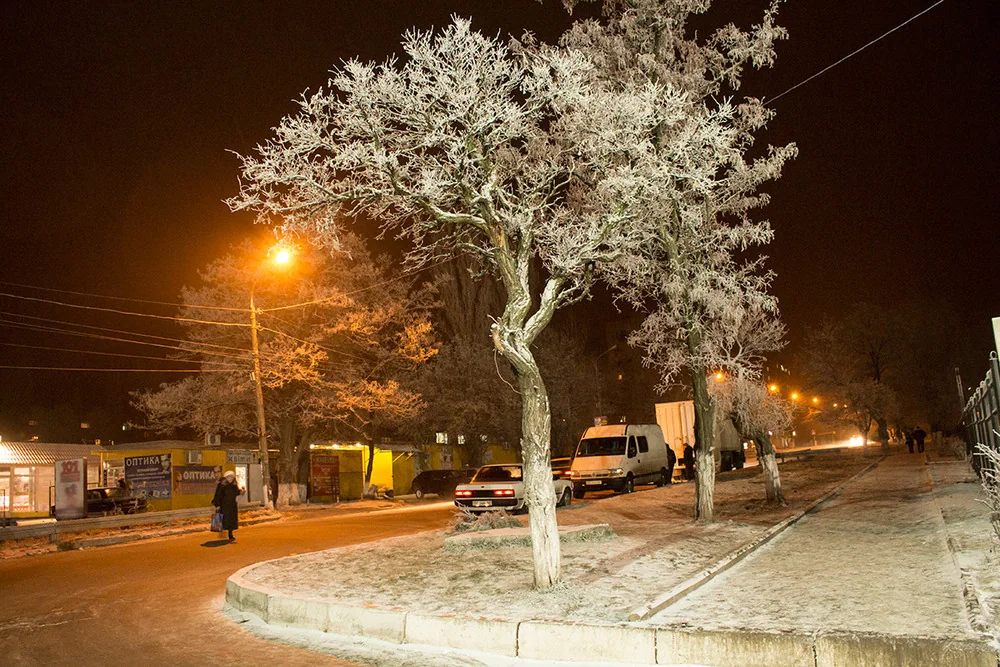
By day you could walk down this street and remember nothing.

Buildings. Cars. Trees. Streetlights.

The usual city scenery.

Then the frost comes.

Hoarfrost appears on the branches.

It grows dark.

The streetlights come on.

And the city, which a few hours ago gave you no reason to look, suddenly becomes a stage set.

The strangest thing is that hardly anything has changed.

The buildings stand where they stood.

The trees have gone nowhere.

The lights were here yesterday.

Only the light has changed.

Photography often teaches us just that.

You do not always have to go far to find a beautiful place.

Sometimes it is enough to return to an ordinary place at a different hour.

After snow. In fog. After rain.

Or on a night when the frost has left a fine white outline on every branch.

We get used to our own routes very quickly.

We stop looking at what we see every day.

Then one evening the light shifts a little.

And the familiar street says:

you’ve been walking past me all this time.

Perhaps what sets a good photographer apart has little to do with seeing more.

It is how long they keep the familiar from turning invisible.

Fireworks in the Mist
STORY 10

Fireworks in the Mist

A Few Minutes of Winter

Winter is usually sparing with colour.

Snow. Stone. Dark water. Grey sky.

But sometimes the morning decides to break its own rules.

The sun touches the fog over the river.

And suddenly the air holds a light that was not there a second ago.

No ray.

No rainbow.

Something in between.

The fog glows from within.

The rocks stay cold. Snow lies on the bank. Water runs through the rapids.

And above it all comes an almost festive flash.

Only without a sound.

No people.

Nobody calling, “Look!”

Things like this have one inconvenient quality.

They do not wait.

You cannot come back tomorrow at nine and ask to see it again.

In a few minutes the sun will climb.

The fog will thin.

The colour will vanish.

And an ordinary winter morning will remain.

Here photography does the very thing that makes us forgive it everything.

It holds what nature had no intention of holding.

One brief meeting of water, cold, sun and air.

A moment that did not know it was special.

Maybe that is why the photograph looks like a firework.

A real firework lasts seconds.

And then all that remains is the memory of the light.